

How To Set Up Salesforce Mobile App
Configuring the Salesforce Mobile App
This guide will bear witness yous how to configure the Salesforce Mobile App using declarative customization and actions in the Salesforce Lightning platform. You will acquire most the features available to customize the Salesforce mobile application user interface, and you will learn how to configure actions and activeness layouts and optimize the Salesforce Mobile App user experience for users accessing the Lightning Platform on the go.
We will cover the following topics:
- Exam objectives — Mobile apps
- Installing the Salesforce Mobile App
- Configuring the Salesforce mobile application user interface
- Building global and object-specific deportment and activeness layouts
Examination objectives — Mobile apps
To consummate the Mobile department of the Certified Platform App Architect exam, app builders are expected to exist able to bear out the following tasks:
- Describe the declarative customization options available for the Salesforce mobile application user interface.
- Given a gear up of requirements, determine the advisable global and object-specific actions and activity layouts to optimize the Salesforce mobile application UX (user experience).
Reference - Salesforce Certified Platform App Builder Exam Guide
This guide is published by Salesforce and can be referenced at https://trailhead.salesforce.com/help?article=Salesforce-Certified-Platform-App-Architect-Exam-Guide.
In the Salesforce Certified Platform App Builder Exam Guide, the full number of questions is given, along with a percentage breakdown for each of the objectives, and an indication of the number of features/functions that tin can exist expected in each of the objectives.
Past analyzing these objectives, percentages, and question counts, we can determine the likely number of questions that volition appear in the exam. For the Mobile objective, there are probable to exist 3 questions in total (v% of 60 total exam questions).
To assistance reinforce the skills and knowledge required to create reports and build dashboards, there is some practical work for you lot to do in Salesforce, and then if you do not have a Salesforce environment in which to carry this out, start create a free developer org.
The options and capabilities of the mobile features volition exist covered in this guide, and you will learn how mobile features enable you to design an appropriate user interface on the mobile platform and optimize the user experience.
Permit'southward now look at the Salesforce Mobile App and larn how to set up the app on mobile devices.
Installing the Salesforce Mobile App
Mobile phones and devices are ubiquitous within both our individual lives and the business environment. In the current climate of mixing work from the office, the home, remotely, and on the move, organizations of all sizes take realized the benefits of using mobile devices to access business applications in today's mobile-first globe.
Mobile application evolution, withal, is not e'er cost-effective, as the terminal production can be expensive to build or fails to meet user requirements. Non all mobile apps developed laissez passer the exam for usability, with apps built for mobile devices often defective functionality and providing a poor user experience. New mobile apps or migrations of desktop apps to mobile sometimes fail equally they are simply mobile screen overlays that are non fit for purpose. This can result in poor user adoption.
The Salesforce Mobile App differs in its approach as information technology is congenital within the Lightning Platform and configurations carried in the desktop are fully integrated and reflected in the mobile app. The mobile offering provided with the Lightning Platform provides a mutual security model and a common set up of configuration features that provide an innovative, responsive, and piece of cake-to-use mobile feel for users.
The Salesforce mobile web browser is no longer bachelor
Prior to the Summertime 2022 release, there were two options for accessing Salesforce mobile features using a mobile device. The first was the downloadable Salesforce Mobile App and and then there was a second option, the Salesforce mobile web browser app, which did not require whatsoever software installation and used the web browser on mobile devices.
Starting from the Summertime 2022 release, the Salesforce mobile web browser app is no longer available. Users must use the downloadable Salesforce Mobile App to admission the mobile features on mobile devices, as detailed in the post-obit article: https://assist.salesforce.com/articleView?id=000349471&language=en_US&blazon=1&mode=1
The Salesforce Mobile App includes many of the customizations that have been configured within the desktop version of your organization and are therefore already partly tailored out of the box to deliver your mobile application requirements.
Permit'due south at present look at which mobile devices are supported for use with the Salesforce Mobile App.
Supported mobile devices for the Salesforce Mobile App
The Salesforce Mobile App is accessible from well-nigh Salesforce editions and types of user licenses and is supported for use with the following 2 operating systems and versions: Apple iOS version 12.0 or afterwards, and Android version 7.0 or afterward.
Salesforce conducts ongoing tests using various mobile phones and tablets to verify that the Salesforce Mobile App operates correctly with the stated platform.
At the time of writing, Salesforce has identified the following mobile phones as supported for use with the Apple iOS platform:
- iPhone 11 Pro and Pro Max
- iPhone 11
- iPhone XR
- iPhone XS and XS Max
- iPhone X
- iPhone 8 and eight Plus
- iPhone vii and seven Plus
- iPhone SE
- iPhone 6S
- iPhone 6
Salesforce has identified the following tablets equally being supported for use with the Apple iOS platform:
- iPad Pro 10.5 inch
- iPad Air 2
- iPad Mini four
At the time of writing, Salesforce has identified the following mobile phones as being supported for use with the Android platform:
- Google Pixel four Xl
- Google Pixel iii
- Samsung Galaxy S10 and S10+
- Samsung Galaxy S9 and S9+
- Samsung Galaxy S8 and S8+
- Samsung Galaxy S7
- Samsung Milky way Notation x+
- Samsung Galaxy Note nine
- Samsung Milky way Note viii
Salesforce Mobile App-supported devices and minimum platform requirements
Salesforce may, at whatever time, change the list of supported devices and minimum platform requirements for the Salesforce Mobile App. The latest set of supported devices and minimum platform requirements can be accessed from the following article:
https://help.salesforce.com/articleView?id=salesforce_app_requirements.htm&type=5
We will at present wait at how to gear up the Salesforce Mobile App on a supported mobile device.
Setting up the Salesforce Mobile App
The Salesforce Mobile App is available from the App Store for mobile devices that are running on the iOS platform and from Google Play for mobile devices that are running on the Android platform.
We will step through the process of setting up the Salesforce Mobile App on an iOS device. The gear up-up process is similar for an Android device, although in that location may exist some small-scale variations.
To access the installation links for the Salesforce Mobile App on an iOS device, perform the following steps:
- Navigate to the Getting started with the Salesforce Mobile App page past browsing to the web URL located at https://www.salesforce.com/solutions/mobile/getting-started/, as shown in the following screenshot:
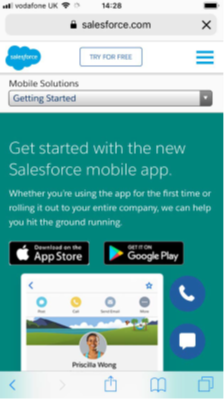
In this setup, we volition install the Salesforce Mobile App on an Apple iPhone that runs under the iOS platform, so hither we'll select the App Shop option.
2. Click on Download on the App Store within the Getting Started screen to navigate to the Salesforce App Shop carte, every bit shown in the following screenshot:

3. Click on Install in the App Store.
4. Wait for a few moments for the installation to complete and the screen will so alter to present an option to open the Salesforce Mobile App, as shown in the post-obit screenshot:
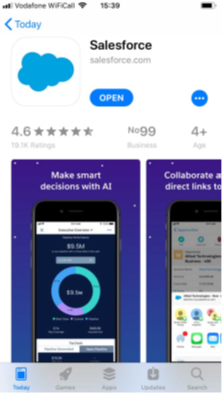
5. Click on Open up in the Salesforce Mobile App and this activity volition (upon navigation to the Salesforce Mobile App for the start time) present the Allow Admission screen, as shown in the following screenshot:
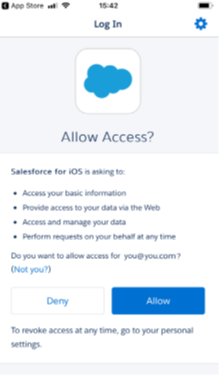
6. Click on Permit to let the Salesforce Mobile App to proceeds access to your Salesforce organization, whereby the screen will and so change to the Welcome to the Salesforce Mobile App screen, as shown in the following screenshot:

7. Finally, click on Get Started to navigate to the Salesforce Mobile App bill of fare, as shown in the post-obit screenshot:
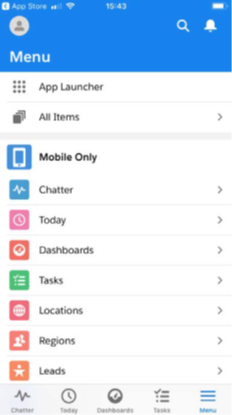
More information well-nigh setting up the Salesforce Mobile App
To detect out more information near setting upward the Salesforce Mobile App, refer to the following article:
https://assistance.salesforce.com/articleView?id=salesforce_app_set_up.htm&blazon=v
This will fix upwards the mobile app. Now let's look at the mobile app UI (user interface) options in the Lightning Platform.
Configuring the Salesforce mobile application user interface
The options and capabilities of the Salesforce Mobile App are not the same equally the full Lightning Platform application, and there are many differences within the Salesforce Mobile App, in particular, concerning the means in which data is entered, screens are presented, and navigation is carried out between screens.
Salesforce has congenital mobile-friendly alternatives to the way information is captured, and navigation takes place accordingly to cater for the much smaller screen real estate and the reduced capability of a mobile device to display functions and features to a user.
Differences between the full Lightning Experience app and the Salesforce Mobile App
For more than detailed information virtually the features that are not available in the Salesforce Mobile App when compared to the total Lightning Experience app, refer to the post-obit article:
https://assist.salesforce.com/articleView?id=limits_mobile_sf1_parent.htm&type=5
The features and capabilities that are bachelor for configuring the Salesforce Mobile App user interface are as follows:
- Lightning App Navigation Menu: The Lightning app navigation menu can be changed by users who take permission to personalize the desktop navigation bar. This also allows a user who has permission to edit the desktop navigation bar, for a given app, to reorder items in the navigation menu inside the Salesforce Mobile App, for that particular app.
- Mobile Just Default Navigation Carte du jour: The Mobile Only app allows you lot to create navigation items that become the default set of items within the Salesforce Mobile App.
- Mobile App Branding: This provides the facilities to configure the fashion in which the app appears.
- Global Quick Actions: These actions in the Lightning Platform can exist idea of equally shortcuts that announced within the user interface. A given global quick action is available in both the desktop and mobile apps and tin can be used to create records, log calls, and so on.
- Object-specific Quick Actions: In the same mode as global quick actions, object-specific quick actions can exist thought of as shortcuts that announced within the user interface. They are also bachelor in both the desktop and mobile apps, but are associated with a specific Lightning Platform object type and can be used to update besides as create records, log calls, and then on.
Customization options in the Salesforce Mobile App
For more information about customizing the Salesforce Mobile App, refer to the following commodity:
https://help.salesforce.com/articleView?id=salesforce_app_customize.htm&type=five
Having looked at options for configuring the user interface, allow'south now wait at how the changes are reflected when personalizing the Lightning app menu in the Salesforce Mobile App.
Customizing a Lightning app navigation carte du jour in the Salesforce mobile app
The Lightning app navigation carte can be personalized by any user who has permission to modify the navigation bar whereby they are able to add, remove (only for items that they accept added), rename, and reorder items.
The modifications to the navigation bar are as well applied to the navigation menu and navigation bar for the specific Lightning app within the Salesforce Mobile App, as shown in the following screenshot:

The preceding screenshot demonstrates reordering by placing the Leads tab to appear as the first item that is reflected in the Salesforce mobile app, as shown in the following screenshot:
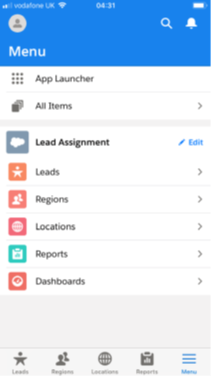
Having identified how the Lightning app navigation menu can be personalized, let's now look at the Mobile Only default navigation menu in the Salesforce mobile app.
Customizing the Mobile Only default navigation menu in the Salesforce Mobile App
The Mobile Just default navigation menu can simply be configured by users with system ambassador permissions and is used to create navigation items that become the default set of items within the Salesforce mobile app.
By configuring the items that are presented to users, y'all can include Lightning pages, Visualforce pages, Lightning components, and so on in the default navigation menu and navigation bar of the Salesforce mobile app.
Modification of the navigation bar for the Mobile Only default navigation bill of fare can be carried out by performing the following steps:
- Navigate to SETUP so search for Salesforce Navigation in the Quick Find search box located at the elevation of the Setup carte on the left sidebar.
- Click on Salesforce Navigation in the SETUP menu.
- In the Salesforce Navigation setup screen, choose the items from the Available list and move them to the Selected list, every bit shown in the following screenshot:

iv. Finally, click on Save.
The Mobile Merely default option shows the selected items in the Salesforce mobile app, as shown in the following screenshot:
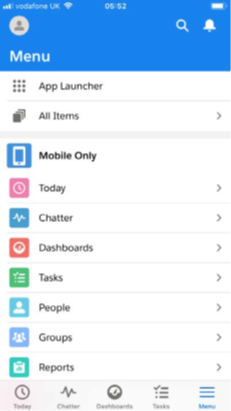
Customization options in the Mobile Only default navigation menu
For more data about customizing the Mobile Only default navigation menu, refer to the following article:
https://assist.salesforce.com/articleView?id=salesforce_app_customize.htm&type=5
We will now wait at the mechanism for setting branding for the Salesforce mobile app.
Mobile app branding
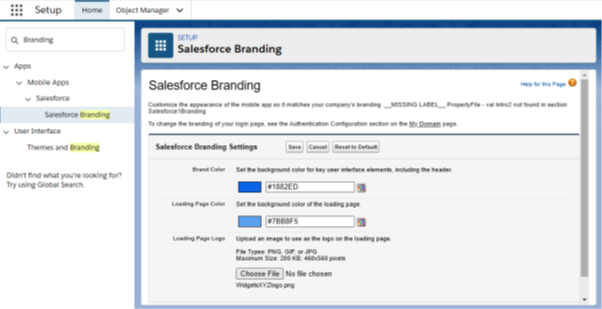
Mobile app branding provides the facilities to configure the manner in which the app appears. Here, the features that can exist configured are the loading page logo, the loading groundwork color, and the header background colour.
Mobile app branding modifications can be carried out by performing the following steps:
- Navigate to SETUP so search for Branding in the Quick Discover search box located at the meridian of the SETUP menu on the left sidebar.
- Click on Salesforce Branding in the SETUP menu.
- In the Salesforce Branding setup screen, click on Edit.
- In the Salesforce Branding edit page, choose the colors for Make Color and Loading Page Color, and so choose a Loading Folio Logo, equally shown in the post-obit screenshot:
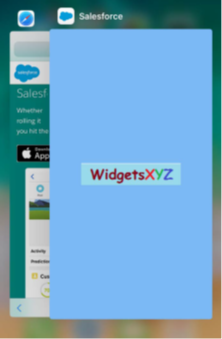
The loading folio colour and loading page logo appear within the Salesforce mobile app, equally shown in the following screenshot:
The brand color appears within the Salesforce mobile app, as shown in the following screenshot:
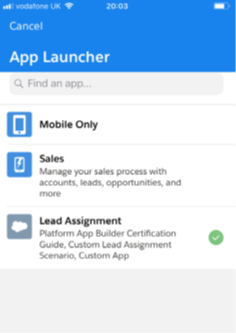
Next, we'll look at the mechanism for building global and object-specific actions and activeness layouts in the Lightning Platform.
Edifice global and object-specific actions and action layouts
Global and object-specific quick deportment in the Lightning Platform can be thought of as shortcuts that announced within the user interface. They are ii forms of what is known as a quick action, which is bachelor in both desktop and mobile apps and tin exist used to create records, update records, log calls, and so on.
In the Salesforce mobile app, global and object-specific quick deportment offer a quick way to access functions that launch a specific action or custom process automation that exists in the Lightning Platform.
In addition to the custom deportment that are tailored to your business processes, the Salesforce Mobile App comes with standard pre-built deportment. The quick actions are located within the activity bar and the action card that appears at the tiptop of the screen of the mobile device.
Quick actions that are used to capture data input have their own blazon of page layout called an action layout and permit you to reduce the number of fields to ensure that only those that are absolutely essential are presented to the mobile user.
In addition to presenting a limited set of fields for information capture, you can also set fields with given values, which are shown on the folio layout, to salve the user fourth dimension when there are records that have common values that are to be entered. This characteristic is chosen prepopulate fields and is bachelor in both the desktop and the Salesforce Mobile Apps.
As an app builder, yous will demand to understand how to build global and object-specific deportment and action layouts in the Lightning Platform and understand the following fundamental differences.
Global quick deportment can be used to create records that are not associated with whatever other record (that is, there is no option to prepare an object relationship field). They are called global quick actions because they can exist placed anywhere within the Lightning Platform where actions are supported such as the Home page, the Churr tab, object pages, and custom Lightning app pages.
Global quick deportment
For more information well-nigh the deportment that can be carried out using global quick actions, refer to the following article:
https://help.salesforce.com/articleView?id=actions_overview_global.htm&blazon=5
Object-specific actions, on the other hand, can be used to create and also update records as they operate in the context of a given Lightning Platform object blazon. Within the Salesforce mobile app, object-specific quick actions can exist placed on record detail pages. So, for example, an action associated with the lead object is but available when viewing a pb record.
Object-specific deportment
For more information about the actions that tin can be carried out using object-specific deportment, refer to the post-obit article:
https://aid.salesforce.com/articleView?id=actions_overview_object_specific.htm&type=five
Let's look at how to create global quick actions in the Lightning Platform.
Creating global quick deportment
In this example, we will add together a New Lead action to global layouts that will allow mobile users to create lead record details from within a Chatter thread. Let's go alee and configure a global quick activity by performing the post-obit steps:
- Navigate to SETUP and so search for Actions in the Quick Find search box located at the top of the SETUP carte on the left sidebar.
- Click on Global Actions in the SETUP menu.
- Click on New Action on the Global Actions setup page.
- In the Enter Action Information dialog screen, enter the following:
- Activeness Blazon: Create a Record
- Target Object: Lead
- Standard Characterization Blazon: — None —
- Characterization: New Lead (Global Action)
- Name: New_Lead_Global_Action
- Description: Platform App Builder Certification Guide, Custom Pb Consignment Scenario, Global Action New Lead
- Create Feed Item: Enabled (when enabled, a feed item is created along with the activity. The meaty layout for the target object sets the fields for the feed detail.)
- Success Message: Lead Created
- Icon: Have the default lead icon for the Lead (icons change co-ordinate to the target object.)
5. Finally, click on the Salvage button to save the global activeness, as shown in the following screenshot:

The options for the action types are as follows:
- Create a Record
- Send Electronic mail
- Log a Call
- Custom Visualforce
- Custom Canvas
- Lightning Component
Upon saving the global action, the layout setup screen appears every bit shown in the following screenshot:
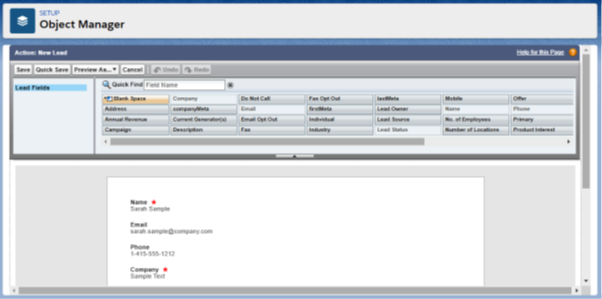
The following fields are added as default: Name, Email, Telephone, Visitor, Championship, and Lead Condition. The Proper name, Company and Lead Condition fields marked with a ruby asterisk are mandatory fields and cannot be removed from the page layout.
6. Remove the following fields, Phone, and Title, past clicking on the Remove icon, as shown in the following screenshot:
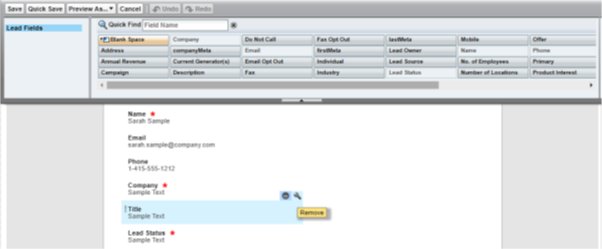
7. Add the post-obit fields by dragging and dropping the field section, as shown in the following screenshot:

8. Finally, click on the Save push button to relieve the global action layout.
Limiting the number of fields on an action layout
Salesforce recommends including fewer than five and observing a maximum number of eight fields on an activity layout, every bit referenced in the following commodity:
https://trailhead.salesforce.com/en/content/acquire/modules/salesforce1_mobile_app/salesforce1_mobile_app_actions_global
To present the New Atomic number 82 global activity as an option in the user interface, we at present need to add the global action to a publisher layout. We can create custom publisher layouts. However, there is a standard layout that we volition apply called the Global Publisher layout. You may demand to check that this layout is included within the profiles within the Publisher Layout Assignment if yous have already made any changes to the Global Publisher layout.
Let's at present go ahead and add the global action to the global publisher layout past performing the following steps:
- Navigate to SETUP so search for Publisher in the Quick Find search box located at the top of the SETUP menu on the left sidebar.
- Click on Publisher Layouts in the SETUP menu.
- Click on Edit for the standard Global Publisher layout.
- If you lot are editing Global Publisher for mobile actions for the first time, you will need to click the override the predefined deportment link, equally shown in the post-obit screenshot:
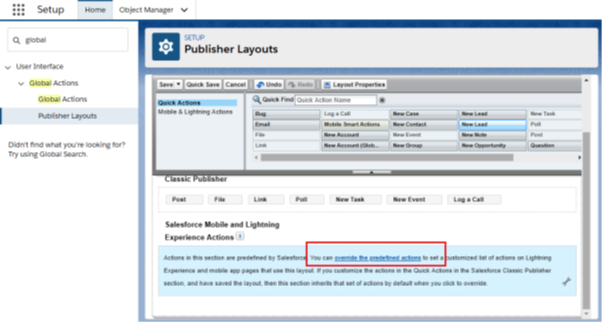
5. Optionally, click on override the predefined actions in the Global Publisher layout.
6. Ensure that New Lead (Global Action) is included within Salesforce Mobile and Lightning Experience Actions, as shown in the following screenshot:

7. Finally, click on the Relieve button to salve the publisher layout.
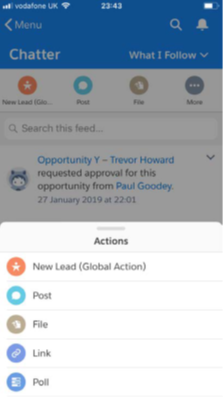
Let'due south now encounter how this looks in the Salesforce Mobile App by navigating to the Chatter item (this tin be plant in the Mobile Merely app). The New Lead (Global Action) selection volition exist presented, every bit shown in the following screenshot:
Next, we'll turn to the practicalities of edifice reports that satisfy a specific business organisation requirement by implementing a study with the use of the Lightning report builder.
Configuring object-specific actions
In this case, nosotros will add a Conciliate action to the location records that will permit mobile users to easily mark the location as inactive from inside a location record.
Let's become ahead and configure an object-specific quick action by performing the following steps:
- Navigate to SETUP and and then search for Object Managing director in the Quick Find search box located at the height of the SETUP menu on the left sidebar.
- Click on Object Manager in the SETUP menu.
- In the Object Managing director setup screen, search for the Location object.
- Click on Location in Object Manager in the SETUP menu.
- In the Location object manager setup screen, click on Buttons, Links, and Actions from within the Location object setup menu on the left sidebar.
- In the Buttons, Links, and Actions department, click on New Action.
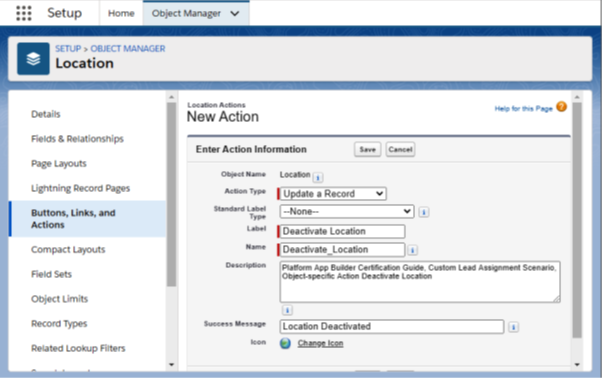
- In the Enter Action Data dialog screen, enter the following information:
- Action Type: Update a Record
- Standard Label Blazon: — None —
- Label: Conciliate Location
- Proper name: Deactivate_Location
- Description: Platform App Builder Certification Guide, Custom Atomic number 82 Consignment Scenario, Object-specific Action Deactivate Location
- Success Message: Location Deactivated
- Icon: Accept the default icon
8. Finally, click on the Save push to save the global action, as shown in the following screenshot:
The options for Activity Types are as follows:
- Create a Record
- Send Email
- Log a Call
- Custom Visualforce
- Update a Record
- Lightning Component
- Menstruum
Upon saving the global action, the layout setup screen appears as shown in the following screenshot:

The following field, Location Name, is added by default and is marked with a crimson asterisk to show information technology is a mandatory field and cannot be removed from the page layout.
- Add the Active field to the action layout.
- Click on the Save button to save the action layout.
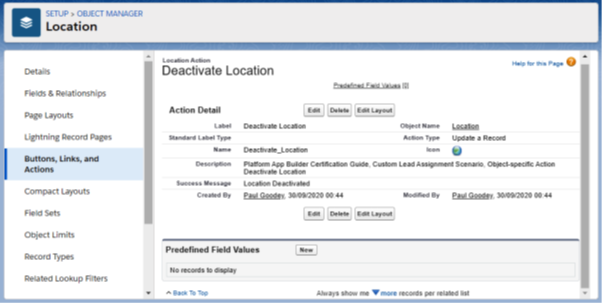
- Upon saving the activity layout, click on New in the Predefined Field Values section, as shown in the post-obit screenshot:
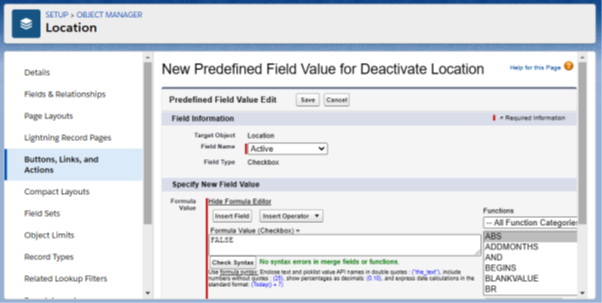
4. In the Enter Action Data dialog screen, enter the following information:
- Field Name: Active
- Specify New Field Value: Formula Value (Checkbox): Faux
v. Click on the Save push button to save the Predefined Field Value, as shown in the following screenshot:
Permit's now add together the object-specific action to the Location page layout by performing the following steps:
half dozen. In the Location object manager setup screen, click on Page Layout from within the Location object setup carte on the left sidebar.
7. Click on the Location Layout page layout.
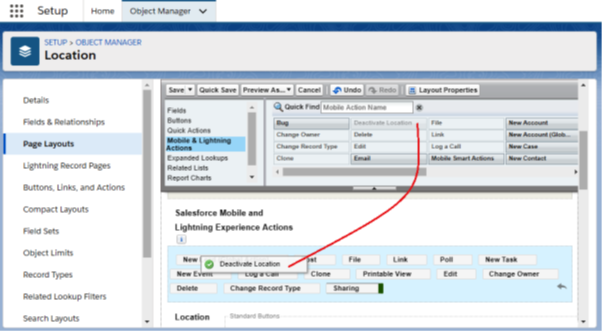
eight. Drag the Deactivate Location action to the Salesforce Mobile and Lightning Feel Actions department of the page layout, as shown in the following screenshot:
ix. Finally, click on the Save push to save the page layout.
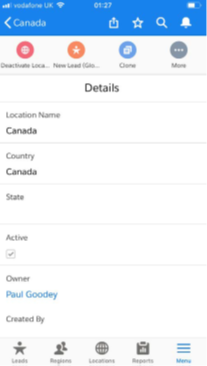
Let'southward now see how this looks in the Salesforce Mobile App past navigating to the Chatter item (this can be found in the Mobile But app). The New Lead (Global Action) option volition be presented, as shown in the following screenshot:
Summary
In this guide for Salesforce developers, we have looked at the options for configuring mobile using declarative customization and deportment in the Salesforce Lightning Platform.
You have learned about the setup and installation of the Salesforce Mobile App and about options for customizing the Salesforce Mobile App user interface.
You have learned how to configure quick actions within the Salesforce Mobile App that can exist used to implement global quick deportment, object-specific actions, and action layouts to optimize the Salesforce mobile awarding user experience.
With this noesis, you are at present well-equipped to tackle the Mobile section of the Salesforce Certified Platform App Builder exam.
This article is part of the Salesforce Platform App Builder Certification Guide by Paul Goodey. To learn how to build apps on the Salesforce Platform and pass the Salesforce Platform App Architect certification test, check out the complete book here.

How To Set Up Salesforce Mobile App,
Source: https://packt.medium.com/configuring-the-salesforce-mobile-app-7dbf65487cf5
Posted by: hudsonqualmitill.blogspot.com
0 Response to "How To Set Up Salesforce Mobile App"
Post a Comment